
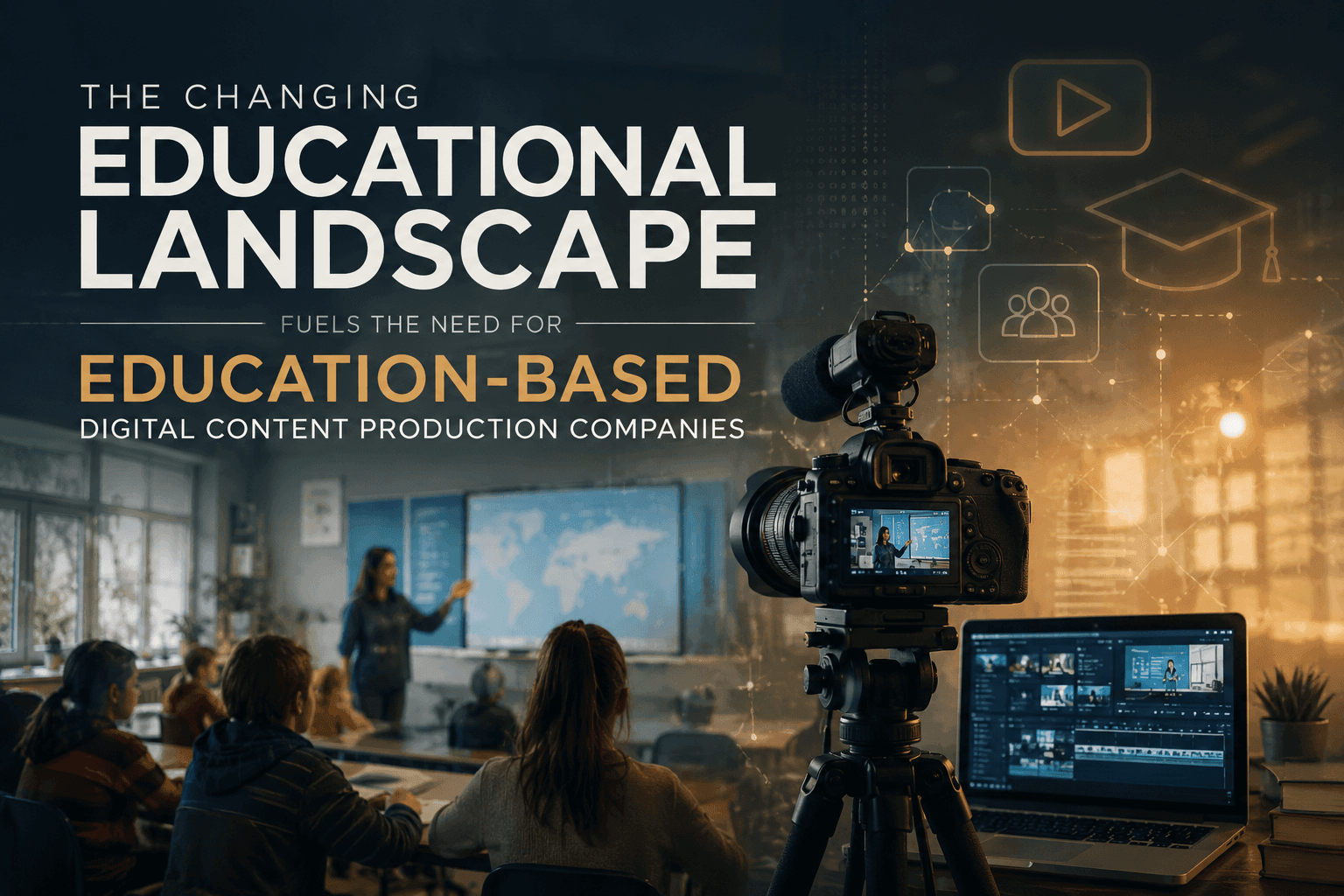
Changing Educational Landscape Fuels Need for
Education-Based Digital Content Production Companies
Asynchronous Professional Modules Meet District Needs
While Providing Breathing Room in the Budget
Jesse Lajimodiere, Lead Special Education Specialist & Lead Producer

Think back to the last time a prospective parent stepped onto your campus and immediately knew it was the perfect fit. Capturing that authentic hallway energy is the essence of visual storytelling. Right now, your website might feel a bit too quiet, lacking that immediate emotional spark. Partnering with a video content production company that specializes in educational video production and K-12 video production can help translate that feeling online with clarity and care.
Text and photos tell families what your educators do, but video actually shows them who you are. This medium—especially educational storytelling videos or documentary style school videos—acts as a digital handshake, warmly welcoming parents before they ever schedule an official tour. Building this vital connection requires strategy, bridging the gap between a simply "pretty" cinematic shot and a compelling message.
According to educational marketing studies, parents must feel absolute trust before choosing a campus for their child. Effective school marketing videos build this confidence by perfectly mirroring the warmth of an in-person open house. Consequently, well-crafted enrollment marketing videos turn hesitant online visitors into eager real-world applicants.
Bottling your unique campus magic requires teaming up with the right creative experts. Understanding how to evaluate a school video production partner ensures your investment leads to more booked tours rather than just a beautiful file. Here is how the best agencies and an experienced education video production company deliver those exact results.
Summary
This guide shows how schools can turn quiet websites into trust-building “digital handshakes” by partnering with education-specialized video producers who capture authentic, FERPA-aware storytelling with clear audio and strong narrative flow. It explains why specialists outperform generalists, identifies the “Big Three” video types (recruitment, testimonials, training), and details how to vet vendors by avoiding red flags like staged scenes, missing B-roll, hidden licensing fees, and weak narratives. You’ll learn budget strategies such as batching and using shot lists to maximize value, along with best practices for licensing and planning. The article closes with a practical 30-day roadmap from concept to a finished, enrollment-driving school video.
Why Professional Video is the New Digital Handshake
When a parent visits your campus, a warm front-office greeting instantly builds trust. Today, that crucial first impression happens online long before they ever step through your doors. High-quality school recruitment videos serve as this vital first introduction, offering families an immediate sense of your culture.
When families watch these tours, they unconsciously evaluate more than just your facilities. This concept is called Perceived Quality, meaning the professionalism of your footage acts as a direct mirror for your school's internal organization. A poorly lit clip can accidentally make an excellent academic program look chaotic, while polished school branding videos communicate that your environment is safe, orderly, and deeply cared for.
Surprisingly, capturing that polished feel has less to do with expensive camera resolutions and everything to do with what parents hear. We have all clicked away from school promotional videos where playground wind completely drowns out a principal's message. Establishing Audio Authority—ensuring every spoken word is crisp and clear—signals competence and guarantees your message actually connects with nervous parents. This is especially true for documentary style school videos that rely on authentic location sound to convey credibility.
Combining that clear audio with the social proof of genuine, unscripted classroom interactions creates a powerful enrollment tool. However, capturing those authentic moments without disrupting the learning environment requires a specific touch, which highlights exactly why hiring a generalist might mean missing your unique message.
The Education Specialist Advantage: Why Generalists Might Miss Your Message
Hiring a local corporate videographer might seem like an easy win, but stunning visuals alone rarely capture a school's true heart. A generalist often focuses on achieving a cinematic look, whereas an education marketing agency prioritizes educational substance—highlighting a teacher's encouraging smile or a moment of quiet peer collaboration rather than just capturing flashy drone shots of the gymnasium.
Beyond securing the right feeling, filming on a campus requires strict adherence to student safety and privacy regulations. You need a team well-versed in FERPA-aware production, meaning they already know how to avoid filming sensitive whiteboard data, recognize privacy lanyards, and blend into hallways without distracting students. Partnering with a dedicated education video production company ensures you never have to waste your morning teaching a vendor basic "School 101." Specialists in school video production also understand how to capture lessons without interrupting instruction or compromising privacy.
To quickly verify if a vendor truly understands the daily rhythm of education, ask them these specific questions before signing a contract:
● How do you identify and seamlessly exclude students who lack signed media releases?
● What is your strategy for lighting and filming in an active classroom without interrupting instruction?
● How do you build a filming schedule around rigid bell times, lunches, and noisy passing periods?
Partnering with a crew that masters these unique nuances guarantees your campus culture is portrayed safely and authentically. The next critical step is planning the exact content formats that drive enrollment.
Essential Content: Reviewing the 'Big Three' Video Types Every School Needs
Capturing beautiful footage is not enough; every video must achieve a specific goal, like driving enrollment or boosting staff retention. To get the highest return on your investment, schools should focus on the "Big Three" video formats, each designed for a distinct audience and outcome.
First are school recruitment videos , serving as the digital front door for prospective families. These highly visual pieces showcase your campus culture to spark initial interest, acting as the welcoming introduction that turns curious website visitors into scheduled campus tours. Districts can adapt similar stories into district recruitment videos to attract great educators and staff.
While tours bring families in, family engagement videos—specifically parent and student testimonials—build the trust needed to keep them. These "social proof videos" work because a happy parent validating your school is infinitely more convincing than a polished brochure. A winning testimonial relies on a simple three-part structure: their initial hesitation before enrolling, the exact moment they knew they chose correctly, and the positive changes they now see in their child.
Internally, modern schools rely on teacher training videos and district training videos to drastically streamline staff onboarding. By utilizing asynchronous professional development—meaning training that educators can complete independently on their own schedule—administrators save countless hours while guaranteeing every new hire receives consistent, high-quality instruction without pulling veterans out of the classroom. This is where elearning video production and online training video production shine, enabling scalable training video production and instructional video production. Many districts now invest in professional development video production as part of broader learning content development and educational content production, including curriculum video production that aligns with standards.
Before planning your shoot, align your strategy using this quick comparison:
● Recruitment Videos: Drives enrollment by visually introducing the campus experience to new families.
● Testimonial Videos: Boosts retention and builds trust through authentic social proof.
● Training Videos: Maximizes district efficiency via on-demand, asynchronous development.
Beyond the Big Three, consider complementary formats such as district communications videos and superintendent message videos to keep your community informed throughout the year. Knowing exactly what to film ensures your project starts strong. However, securing the right production partner requires watching for specific warning signs.
How to Vet Your Production Partner: 4 Red Flags to Avoid
Hiring the right agency for your school marketing videos requires looking past flashy camera gear. When interviewing a video content production company, you need a partner who understands how to capture the authentic heartbeat of your hallways, a key distinction that elevates professional production versus DIY school filming. A polished portfolio must actually reflect the lived experience of your students rather than just looking cinematic.
Protect your investment by watching for these four red flags during your vetting process:
● Staged classroom scenes: If students look like rigid actors, the final product will feel unnatural to prospective parents seeking authenticity.
● Missing B-roll: "B-roll" refers to the secondary footage—like close-ups of science experiments or recess games—that keeps viewers visually engaged while someone speaks off-camera.
● Hidden licensing fees: Vague contracts often leave schools footing surprise bills for background music rights or extra editing rounds.
● Lacking narrative flow: Videos without a clear, emotional progression are simply random collections of clips, not compelling stories.
Educational video production relies heavily on that supplemental B-roll to maintain momentum and visually prove your claims. Imagine a principal praising your vibrant arts program; without B-roll showing students actually painting, the message falls flat. Similarly, failing to clarify music licensing fees upfront can result in your video being muted on social media due to copyright claims right when your enrollment campaign peaks. Reliable professionals proactively outline how they will build your narrative flow and transparently detail all costs before cameras ever roll. Maximizing this investment relies on smart scheduling and preparation.
Maximizing Your Budget: Strategies for Affordable Professional Filmmaking
Stretching your budget for school promotional videos and school video production simply requires smart scheduling. Using a strategy called "batching," you can significantly reduce a videographer's daily rate by filming multiple scenes back-to-back in a single day. Focus this concentrated time on capturing "evergreen content"—footage of timeless school moments, like engaged library reading or active recess games, that will remain relevant on your website for three or more years.
Another way to keep costs down is by handing your crew a detailed "shot list" before they even arrive on campus. This straightforward checklist tells them exactly what scenes need to be filmed, ensuring no hourly rate is wasted wondering where to go next. When your team isn't wandering the hallways searching for inspiration, they can efficiently maximize affordable equipment for educational filmmaking to capture the best possible lighting and angles.
Thoughtful preparation remains the true secret to getting premium results without the premium price tag. Approaching educational media production with these organized strategies guarantees every dollar spent translates directly to the screen.
Your 30-Day Roadmap to a Finished Video
You no longer have to guess how to showcase your campus. You now possess the blueprint to translate your daily hallway energy into compelling school marketing videos.
To start increasing enrollment with video content, execute this 30-day plan:
1. Choose your core focus (Tour, Testimonial, or Spirit).
2. Outline three essential scenes to film.
3. Walk the campus to identify bright, welcoming locations.
4. Schedule enthusiastic parents for interviews.
5. Plan your format for website, social media, or district communications videos.
Instead of viewing enrollment marketing videos as technical hurdles, treat them as your most powerful welcoming tool. By sharing your school's authentic heart, you empower families to confidently connect with your community before they ever step inside—and your chosen video content production company can help you sustain that momentum across seasons and platforms.
Top Video Content Production Company for Schools Reviewed
Frequently Asked Questions
Question: Why is professional video called a “digital handshake,” and why does audio matter so much?
Short answer: For most families, the first impression of your school now happens online, so video becomes the warm welcome that used to occur at the front desk. Parents read “Perceived Quality” from what they watch—polished, well-organized visuals and especially clear sound suggest a safe, well-run campus. Establishing “Audio Authority” (crisp, intelligible dialogue without wind or background noise) is more decisive than ultra-high resolution because it ensures your message lands. Pairing clear audio with genuine, unscripted classroom moments builds trust and turns curious visitors into scheduled tours.
Question: How do education-specialized video teams outperform generalists on campus?
Short answer: Specialists prioritize educational substance and safety over flashy shots, capturing authentic teacher–student interactions without disrupting learning. They’re FERPA-aware, know to avoid sensitive whiteboard content, recognize privacy lanyards, and plan around bell times, lunches, and passing periods. You won’t have to teach them “School 101.” To verify expertise, ask:
● How do you identify and seamlessly exclude students without signed media releases?
● What’s your approach to lighting/filming in active classrooms without interrupting instruction?
● How do you build a filming schedule around rigid school rhythms (bells, lunches, noisy passing)?
Question: Which video types should we prioritize, and what outcomes do they drive?
Short answer: Focus on the “Big Three,” each with a distinct goal:
● Recruitment videos: Your digital front door—spark interest and convert website visitors into campus tours. (Districts can adapt these to recruit staff, too.)
● Testimonial (family engagement) videos: Social proof that builds trust and retention through real parent/student voices.
● Training videos: Asynchronous professional development that standardizes onboarding and saves admin time.
Complement with district communications and superintendent message videos to keep your community informed year-round.
Question: What red flags should we watch for when vetting a production partner?
Short answer: Four signals of risk:
● Staged classroom scenes that feel unnatural to parents seeking authenticity.
● Missing B-roll; without cutaway footage (labs, art, recess), speeches feel flat and claims go unproven.
● Hidden licensing fees for music or extra edits that create surprise costs—or cause your video to be muted on social media.
● Weak narrative flow; random clips aren’t a story.
Reliable partners explain how they’ll build narrative momentum and list all costs up front.
Question: How can we maximize our budget and move from idea to finished video quickly?
Short answer: Use batching to film multiple scenes in one day, prioritize evergreen moments (reading time, collaborative projects, recess) that stay relevant for years, and provide a detailed shot list so the crew isn’t wandering between locations. Thoughtful prep turns affordable gear into premium results. A simple 30-day roadmap:
1. Choose your core focus (Tour, Testimonial, or Spirit).
2. Outline three essential scenes.
3. Walk campus to pick bright, welcoming locations.
4. Schedule enthusiastic parents for interviews.
5. Plan formats for website, social, and district communications.

Jesse Lajimodiere is a filmmaker, educational strategist, and Lead Special Education Specialist with over 25 years of experience in education and district leadership. He specializes in cinematic educational media, professional development systems, and training content for schools and organizations.

Cinematic Storytelling.
Strategic Production.
Studio-Quality Results.
Up From The Ashes Productions
Littleton, Colorado
303-351-2381
upfromtheashesproductions.com
Up From The Ashes Digital Productions LLC
Designed and produced by Up From the Ashes Productions, all rights reserved.